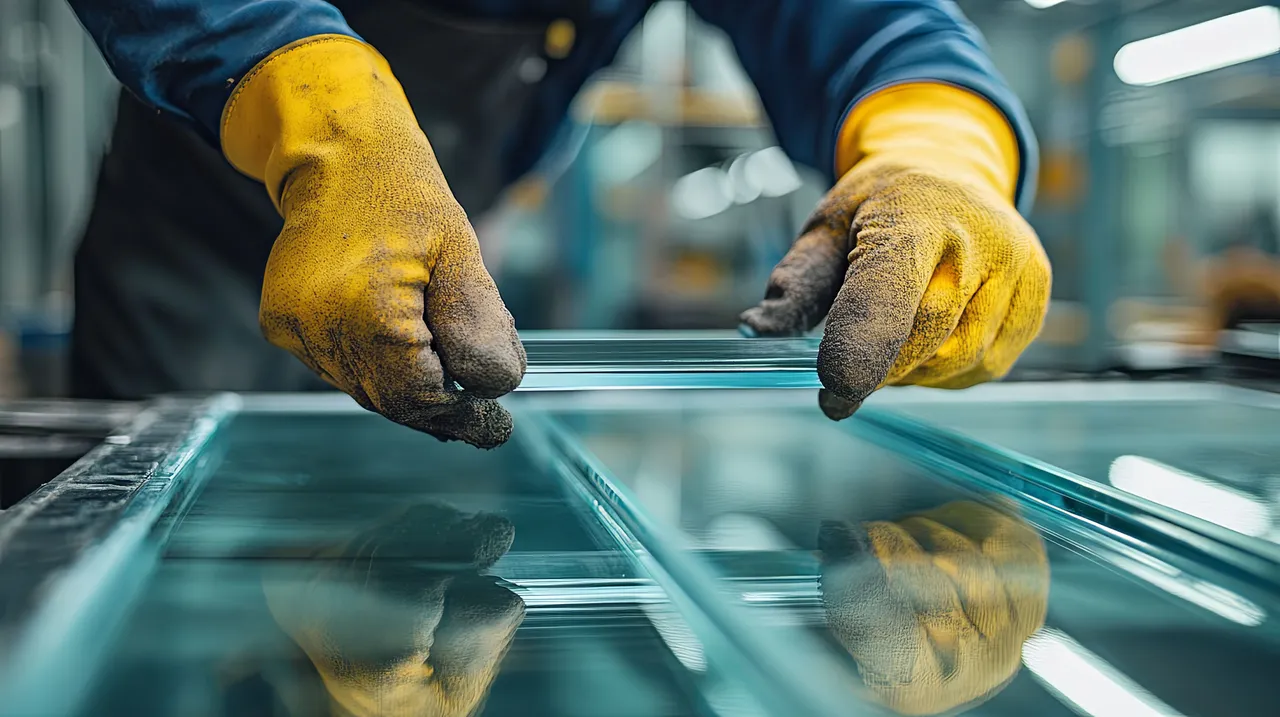
A lot of glass equipment gets ordered off a single line of text. Glass reactor, 100 litre, quote please. If a reply comes back inside the hour, somebody has probably guessed the temperature, the pressure, the joints and the frame for a plant they have never walked through.
Industrial glass fabrication is the shaping and joining of borosilicate glass into vessels, columns, valves and sight glasses made for one plant’s conditions. Glass fabrication in Vadodara works best when the buyer starts with temperature, pressure, chemistry and connection details, because those fix the wall thickness, the joints and the supports before any glass gets heated.
Chemicals in India is hard to generalise about. KPMG in India, working from 2025 IBEF figures, puts the industry at over 80,000 products and more than two million jobs. Two plants can both say 100 litre reactor and mean entirely different things.
Table of Contents
What Is Industrial Glass Fabrication?
Walk into a fabrication workshop and the glass looks nothing like the finished equipment. It arrives as tube, rod and sheet. A glassblower softens it in a torch flame, shapes it, and seals one piece to the next until the drawing is matched, which is how ILPI’s scientific glassblowing guides describe the work for a research lab too. Borosilicate glass fabrication for a plant is that craft with the volume turned up: wider bores, thicker walls, and far more worry about what is holding everything up. Scientific glass fabrication for a lab bench is the small version of the same job.
The phrase industrial glass manufacturing covers a lot more ground, from bottles to float glass, and has little in common with a reactor flange.
What nobody sees at this stage is strain. Every cycle of heating, forming and cooling leaves some behind. Under a polariscope it shows as coloured bands, and the only cure is slow cooling in a furnace, which is the step a rushed job tends to skip. A flange can look perfect on the bench while carrying a load nobody has measured.
How a fabricator checks for strain tells you more about the workshop than the finished piece does.
Why Borosilicate Glass Is Used for Industrial Fabrication
Chemistry is usually the first reason. De Dietrich’s data on borosilicate 3.3 gives a short list of things that visibly attack it: hydrofluoric acid, concentrated phosphoric acid, and strong caustic at higher temperatures. Cold caustic is a gentler case, with solutions up to 30% handled without difficulty, so the question for any given duty is less “does it contain alkali” and more “how hot and how strong”. Almost everything else a chemical plant circulates is fine.
On heat, the standard range in GMM Pfaudler’s 2020 catalogue is -50 to 200°C, while QVF goes down to -80°C. The glass would not begin to deform until around 525°C, but nobody runs a plant near that figure, because stress and pressure set the limits much earlier. Thermal shock is where people read the most into the material. Borosilicate copes with temperature change far better than ordinary glass, yes. QVF still caps sudden shock at 120 K and the gap between product and ambient at 180 K, and past those numbers the thermal stress starts eating into the pressure rating.
Then there is the simplest advantage, which is that you can see in. Colour, level, foam, a precipitate starting to form: operators read all of it without opening anything, and the smooth, non-porous wall gives residue very little to cling to. Swastik’s post on process monitoring goes further into that side.
What Types of Industrial Glass Components Can Be Fabricated?
Catalogues run long, though requests tend to land in five places.
Vessels and stirrers account for a large share. A glass vessel can serve as a reactor, receiver, reboiler or separator, and some only store, feed or measure. The stirrer looks like an add-on in the order sheet, yet once a batch is running the drive above it loads the top nozzle every minute. Swastik Industries has been building borosilicate equipment in Vadodara since 2004, with vessels now reaching 200 litres, and the steel frame gets made alongside because the two are designed together.
A sight glass can be as plain as a clear tube connected to the top and bottom of a tank, so the liquid in the tube stands at the same level as the liquid in the tank. Windowed versions sit in lines and vessel walls.
Column work is built from sections, with adapters, reflux dividers and packing supports added where the separation calls for them. Because it is all glass, everyone can watch during trials, which is half the value in pilot work.
Valves and filters usually pair glass with PTFE on the wetted side, keeping the flow path inert, and the transparent body shows whether the valve is doing its job.
Whatever falls outside all that goes under custom glass components: an odd nozzle angle, a bend cut to clear a pipe that is already there, a length that fits under a low ceiling. Tubular supporting structures and frames in steel or cast iron belong in this group, and Swastik builds them from the plant’s own drawing instead of a catalogue size.
What Factors Should Be Considered When Fabricating Industrial Glass Components?
Start with what the glass is actually for: reacting, storing, distilling, watching. Name the chemicals and their strengths while you are at it, because caustic at 30% and room temperature is fine and the same caustic hot is not.
Size matters for more than fit. De Dietrich rates permitted pressure by nominal diameter, so a wider part is not just a bigger part, it carries a different limit. Volume, heights and the free space around the equipment all go in the brief for that reason.
Process conditions are where briefs get thin. Temperature and pressure are not two separate numbers. According to De Dietrich’s operating guidance, the stress caused by a temperature difference across the wall piles on top of the stress from working pressure, and the more total stress there is, the less pressure the part is allowed to take.
In glass process equipment, the permitted pressure is not a fixed number, because temperature takes a share of it.
Design values are conservative on purpose. The EN 1595 figure for tensile and bending stress in borosilicate 3.3 is just 7 N/mm², with a safety factor that covers the tiny surface damage handling leaves behind. Glass copes with squeezing far better than with pulling or bending, so a duty with violent temperature swings, or pressure above the rating for its size, may belong in another material. A good fabricator will say so before quoting.
Connections deserve an hour of their own, since glass, gaskets and the steel behind them move differently as temperatures change. Büchi describes a flexible joint that lets glass pipework go together under pressure or vacuum with no mechanical stress, because it allows movement along and across the pipe. In our experience the first drawing is rarely the final one, and most revisions gather around the joints.
Equipment integration is everything else meeting at one vessel: stirrer drive, condenser, probes, feed lines, frame. Supports carry the weight, never the glass. Leave room for a spanner at every joint and plan the lifting path before the vessel arrives (doorways get forgotten more than anyone admits).
Industrial Applications of Fabricated Borosilicate Glass
Chemical processing takes the biggest share, with reactors, distillation sets and acid handling. GIDC lists Nandesari, in Vadodara district, among Gujarat’s chemical estates, so a workshop on Ajwa Road is close to the plants it serves.
Pharma buyers worry about residue and paperwork. Büchi notes that borosilicate 3.3’s smooth, non-porous surface cuts deposits to practically nothing, and together with plant documentation it helps meet GMP requirements. For these buyers the documents that ship with the glass are part of the product, so ask early.
Labs and pilot rigs sit between the bench and the plant. ILPI points out how heavily chemical, medical, pharmaceutical and engineering laboratories rely on scientific glassware, and pilot work picks glass first for one reason: a chemist can watch the reaction and change something on the spot.
In mixed plants, process equipment ends up a patchwork. A clear line between two steel vessels, a glass heat exchanger in a corrosive stream, a column the team wants to follow by eye.
Common Mistakes When Choosing Industrial Glass Fabrication Services
The most frequent mistake is the one-line enquiry from the opening. A quote that asks nothing about your process is a quote for the wrong glass. Close behind it comes the borrowed spec, where a drawing from the plant next door carries its chemistry into yours.
Pressure ratings cause trouble too. A rating is not one figure, and the number worth asking about is the one at your own operating temperature. Frames and joints get pushed to later more often than they should, even though they decide how long the glass lasts, so name them in the first enquiry.
Hardly anyone asks how strain is checked. Is the piece annealed in a furnace? Does anybody look at it under a polariscope? A workshop doing the job properly will be glad you asked.
Prices are another trap. One quote includes the frame, the gaskets and testing, while another stops at the glass, so line them up on the same footing before comparing.
Finally, plenty of buyers never visit. Any borosilicate glass manufacturer Vadodara has within driving distance is close enough to walk through, and buyers in India lean heavily on trust before committing. A walk around the workshop settles things a brochure will not.
FAQ: What Most People Ask Before Ordering
Q: How is borosilicate glass equipment fabricated for industrial use?
A: Fabricators start with borosilicate tube, rod or sheet and heat it with a torch until it can be shaped and joined to the drawing, then fire-polish the edges. All that heating leaves strain in the glass, so finished pieces are annealed, and a polariscope shows whether any stress remains. Metal supports and fittings come afterwards. Since strain cannot be seen by eye, the annealing step is easy to underrate.
Q: How much pressure can borosilicate glass equipment take?
A: No single number answers it. Permitted working pressure depends on the component’s nominal size, and it falls as thermal stress rises, since both loads act on the same glass wall. A plant as a whole is generally held to its weakest rated part. When you ask a supplier, request the rating at your real operating temperature, because a headline figure quoted at room temperature can mislead.
Q: What is the difference between a borosilicate glass manufacturer and a glass fabricator?
A: A manufacturer makes the raw borosilicate, usually as tubing, rod or sheet. A fabricator forms that material into finished equipment such as vessels, columns and valves. Plenty of suppliers do some of both, so it is fair to ask where the glass comes from and which steps happen in the workshop. Swastik Industries builds finished process equipment in Vadodara, and buyers can ask it directly what is done in-house.
Q: What temperature range can borosilicate glass equipment work in?
A: Standard borosilicate 3.3 equipment is usually rated from about -50°C to 200°C, and some makers quote down to -80°C. These ratings assume no sudden shocks. A quick jump across the glass wall adds stress and cuts the allowed pressure, and one maker caps thermal shock at 120 K. Jacketed vessels get checked separately, so give the supplier your full utility range when you enquire.
Write the Brief First, Ask for the Price Second
Comparing options for glass fabrication in Vadodara gets easier once there is a one-page brief: the chemicals, the temperature range, the pressure, the volume and a sketch of the space around the equipment. Give the same page to Swastik Industries and to one other supplier, then see what each of them asks you in return. Those questions will tell you more than the two prices.
The cheapest time to fix a glass component is while it is still a line on a drawing.